Home
Our Loft
Quilts, Gifts, Decorating, Restin' & Relaxin', Pampering
Craftin' Room
Kids Fun Stuff
Crafts for the
Kid in all of us
Special Occasions
Heart of our Home
Recipes, Crafts, Cookbooks, Tips, Gifts
Readin' Room
Craft Books, Antiques and Collectibles, Gardening and more
From the Porch
Gardening
Helpful Tips
Products
General Store
Stroll the Aisles
Special Occasions
Crafts & Gifts
About Us Folks
E-Mail
Links
Amaryllis, gifts that bloom
Contact Info
Comfy Country Creations
P.O. Box 10181,
Airdrie, Alberta
T4A 0H5
Phone: 403-912-2645
Fax: 403-912-0543
|
|
Composting Basics
If there is one undertaking that everyone has a special recipe for
it has to be the making of compost.
Any organic material is suitable for the purpose, from food scraps,
grass cuttings, pruning and leaf rakings, to animal manures, blood and bone. You can even use paper and any natural fibers
such as wool and cotton.
These materials will all break down to form a rich and crumbly
compost, ideal for use as garden soil enrichment, plant food and
as mulch.
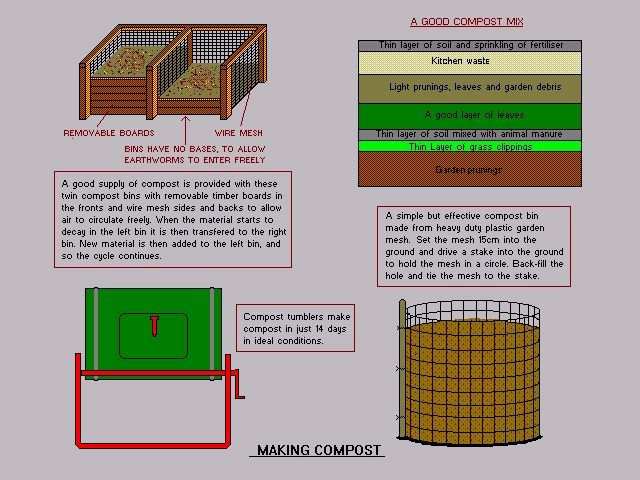
Click on picture for large view.
Copyright (c) 1990-2002, Brian Rondel,GrowIt Gold, Innovative Thinking Software, All Rights Reserved
- Keep your compost moist but not wet.
As the decomposition process gets underway, heat is generated
which helps the material to break down.
This heat serves to kill any weed seeds, virus diseases and fungus
that may be present.
Preferably have at least two heaps, bins or boxes in use at the same
time so that a cycle can be established to provide a constant supply.
(see graphic illustration)
One bin is used for new material while the other is maturing.
About three weeks after starting a new bin, fork the contents from
the top and sides of the mature heap onto the new one and cover
with a layer of soil and straw.
Alternatively the top and side layers can be used to start a new
heap, when this top layer becomes the bottom layer of the new heap.
An eight to fourteen week cycle is normally required in good weather
to fully decompose the contents of a new heap.
- If odor becomes a problem, sprinkle a thin dusting of agricultural
lime on the heap.
Also apply a dusting of blood and bone and ash to help the process
of decomposition along.
Avoid adding bulbous weeds, nut grass, onion weed, wandering jew,
and kikuyu runners, as these may survive the internal heat of the
heap and become a nuisance in the finished product.
- Add these roots and weeds that resist breaking down to a large container of water, this will make it rot and you have nutritious "green tea" to water your garden with.
Add a little slow release fertilizer to the heap to add nutrients
to the mixture as it percolates down through the material.
Comfrey and Borage are 2 herbs that help to quickly break down the compost pile.
- Your compost is ready to use when you can no longer recognize the
contents of the heap or bin.
NOTE: Graphics are GrowIt Gold (tm)Copyright (c) 1990-2002, Brian Rondel, Innovative Thinking
Software, All Rights Reserved.
Check out our other related articles and pages.
Tips for Outside
Garden Supplies
Side Gardens
Lavender Sachets
Wreath Making
Outside Tips
|