Comfy Country has craft
							ideas and products for everyone and for every area of your home and garden.


Pot Pourri
Ingredients


Flowers and Woods


Comfy Country Creations has ideas and lovingly crafted products for your home.


Home


Our Loft
Quilts, Gifts, Decorating, Restin' & Relaxin', Pampering


Craftin' Room
Kids Fun Stuff
Crafts for the
Kid in all of us
Special Occasions


Heart of our Home
Recipes, Crafts, Cookbooks, Tips, Gifts


Readin' Room
Craft Books, Antiques and Collectibles, Gardening and more


From the Porch
Gardening
Helpful Tips
Products


Helpful & Handy Tips
Kitchen, Outside Help, Individual Items


Special Occasions
Craft Ideas and Gifts


About Us Folks

E-Mail

Links

" The Periodical "
subscribe today


Drying your gardens flowers is a great way to preserve their beauty and create beautiful crafts.

Preserving Flowers


 Unique flower holders to decorate your table.

Easy Centerpieces


 Unique flower holders to decorate your table.

Essential Oils


joanne.com


Kalyx.com - Complete Aromatherapy Oils & Supplies


Kalyx.com Herbs, Foods, Spices, Coffees & Teas


only the best 2


Dried Organic Herbs


Make Scented Waters


Make Pot Pourri


Spices


Herb Cook Books


Spiced Amour Pomanders


Pot Pourri Recipes


Aromatherapy for Mind, Body, & Spirit with Herbal Remedy


Aromatherapy Books


joanne.com


Kalyx.com - Complete Aromatherapy Oils & Supplies


Kalyx.com Herbs, Foods, Spices, Coffees & Teas


Herb Cook Books


Aromatherapy Books


Citrus Peel


GiftTree


Contact Info

Comfy Country Creations
339 Tanner Drive,
Airdrie, Alberta
T4A 1S5

Phone: 403-912-2645
Fax: 403-912-0543


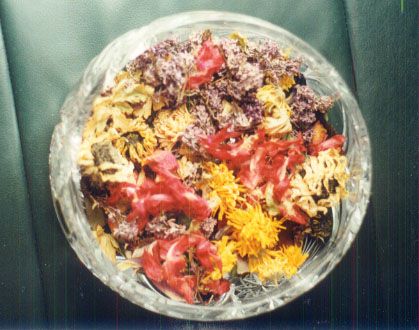
For your convenience we have provided links for the flowers and woods needed to make our Pot Pourri.


Roses, Red Flowers & Petals Whole 1 lb. Roses, Red Flowers & Petals Whole 1 lb.

Infuse for a tonic and astringent tea, specifically good for coughs. Proven effective for oral inflammations, in Asian medicine, Rose flower tea is also used to treat cough, wounds, and excessive sweating. Make rosewater as an antiseptic tonic. The flower has astringent and antibiotic properties, drying and tightening the tissues. The petals are often added to healing incenses and sachets. Scatter the rose petals in the bed chamber on your honeymoon. Grieve: The petals of the dark red Rose, R. gallica, known as the Provins Rose, are employed medicinally for the preparation of an infusion and a confection. In this country it is specially grown for medicinal purposes in Oxfordshire and Derbyshire. The British Pharmacopoeia directs that Red Rose petals are to be obtained only from R. gallica, of which, however, there are many variations. The main point is that the petals suitable for medicinal purposes must yield a deep rose-coloured and somewhat astringent and fragrant infusion when boiling water is poured upon them.


Roses, Pink Buds & Petals Whole 1 lb. Roses, Pink Buds & Petals Whole 1 lb.

Infuse for a tonic and astringent tea, specifically good for coughs. Proven effective for oral inflammations, in Asian medicine, Rose flower tea is also used to treat cough, wounds, and excessive sweating. Make rosewater as an antiseptic tonic. The flower has astringent and antibiotic properties, drying and tightening the tissues. The petals are often added to healing incenses and sachets. Scatter the rose petals in the bed chamber on your honeymoon. Kings: This rose, on account of its delightful fragrancy, is principally employed in France for the distillation of rose-water, so much used in collyria and other lotions. Grieve: In modern herbal medicine the flowers of the common Red Rose dried are given in infusions and sometimes in powder for haemorrhage. A tincture is made from them by pouring 1 pint of boiling water on 1 OZ. of the dried petals, adding 15 drops of oil of Vitriol and 3 or 4 drachms of white sugar. The tincture when strained is of a beautiful red colour. Three or four spoonsful of the tincture taken two or three times a day are considered good for strengthening the stomach and a pleasant remedy in all haemorrhages.


Sandalwood Red C/S 1 lb. Sandalwood Red C/S 1 lb.

A traditional Indian incense and dye wood for ritual, meditation and candlemaking. Aside from its use as incense, Red Sandalwood is valued mainly as a source of red dye. At one time, it was used to dye wool. Today, it's a brightening agent in tea mixtures and a coloring agent in toothpaste. Little is known about its effects in the body, although it has a considerable Ayurvedic reputation. No known medical conditions preclude the use of Red Sandalwood, and there are no hazards on record.


Jasmine Flowers Whole 1 lb. Jasmine Flowers Whole 1 lb.

Grieve: A palatable syrup can be prepared from the flowers. A preparation of the flowers has been employed medicinally for coughs and hoarseness.


Lavender Flowers Whole 1 lb. Lavender Flowers Whole 1 lb.

This beautiful herb has many uses, culinary, cosmetic and medicinal. It is used as an infusion, decoction and bath additive. It is an effective herb for headaches, especially when they are related to stress. The German Commission E approved the internal use of lavender for restlessness or insomnia and nervous stomach irritations. The German Standard License for lavender tea lists it for restlessness, sleeplessness, lack of appetite, nervous irritable stomach, meteorism, and nervous disorders of the intestines. The volatile or essential oil of lavender contains many medicinal components, including perillyl alcohol, linalool, and geraniol. The oil is calming and thus can be helpful in some cases of insomnia. One study of elderly persons with sleeping troubles found that inhaling lavender oil was as effective as tranquilizers. A lavender bath before bedtime is soothing to rheumatism and sleeep-inducing. Grieve: Lavender was used in earlier days as a condiment and for flavouring dishes 'to comfort the stomach.' Gerard speaks of Conserves of Lavender being served at table. It has aromatic, carminative and nervine properties. Though largely used in perfumery, it is now not much employed internally, except as a flavouring agent, occurring occasionally in pharmacy to cover disagreeable odours in ointments and other compounds. A tea brewed from Lavender tops, made in moderate strength, is excellent to relieve headache from fatigue and exhaustion, giving the same relief as the application of Lavender water to the temples.


Cinnamon/Cassia Chips, < Cinnamon/Cassia Chips, <" - 1" Cut (2% oil) 1 lb.

Cassia also called Chinese Cinnamon, spice consisting of the aromatic bark of the Cinnamomum cassia plant of the family Lauraceae. Similar to Cinnamomum zeylanicum, cassia bark has a more pungent, less delicate flavour and is thicker than cinnamon bark. It contains from 1 to 2 percent oil of cassia, a volatile oil, the principal component of which is cinnamic aldehyde. Its extraordinary unique flavour made cinnamon once more valuable than gold. Cassia bark is used as a flavouring in curries, pastries, liqueurs and chocolate. Southern Europeans prefer it to Cinnamomum zeylanicum, but, in North America, ground cinnamon is sold without distinction as to the species from which the bark is obtained.


Hibiscus Flowers C/S Cert. Org. 1 lb. Hibiscus Flowers C/S Cert. Org. 1 lb.

Makes red zinger tea, mixed with any number of other herbs. The flower is a good adddition to spicy salads, and it makes a fruity, fragrant smoke.


Honeysuckle Flowers Whole (Jin Yin Hua) 1 lb. Honeysuckle Flowers Whole (Jin Yin Hua) 1 lb.

Honeysuckle flower tea, used as part of a healthy lifestyle, may help to lower cholesterol. In Appalachian folk medicine, honeysuckle is valued as a remedy for forgetfulness. This herb has broad-spectrum antibiotic properties and can be used for all infections and inflammations. Reputedly effective against respiratory tract infections and some gastrointestinal tract inflammations. Also used for fevers, the common cold, sore throat, and influenza. Honeysuckle, usually prepared as an infusion, is useful for all sorts of infections, inflammations, and short term illnesses such as the flu. Honeysuckle flowers are effective against bacteria, viruses, fungi, and parasites. They are also useful as a diuretic and mild laxative. This combination of properties has lead to their widespread use as an ingredient in detoxifying formulae. Honeysuckle is also a very useful remedy for persistent acne, and all sorts of skin eruptions. Sore throats and other forms of internal soreness can be alleviated by the inflamation reducing effect of honeysuckle.


Cedar Chips Large Red 1 lb. Cedar Chips Large Red 1 lb.

The fragrant wood chips are popular for adding a smoked flavor to fish and meats when cooked with them, cabinets, fence posts, pencils, garden and pet bedding, potpourris, sachets and as purifying incense for meditation and magic. Eastern red cedar, also called Pencil Cedar, is an evergreen ornamental and timber tree of the cypress family, native to eastern North America.


Chamomile Flowers, German Whole Cert. Org. 1 lb. Chamomile Flowers, German Whole Cert. Org. 1 lb.

Modern clinical studies have confirmed that German chamomile and Roman chamomile share many of the same constituents, and that chamomile does indeed live up to its traditional reputation. Taken as a tea or liquid extract, chamomile can alleviate intestinal pain from gas, heartburn, and ulcers. Chamomile ointment can help reduce symptoms of psoriasis and eczema and help heal burns. Steeped chamomile flowers, or tinctures (solutions made from herb and alcohol, or herb, alcohol, and water), in the bath, can help heal a number of skin problems, including hemorrhoids. The inhaled steam from an infusion or decoction helps alleviate cold symptoms, and the tea or decoction itself can be used as a mouthwash or gargle to help reduce pain from gum disease or mouth sores. The traditional herbalists, of course, stress chamomiles main traditional function  that of a safe and soothing nervine. Kings: Matricaria [German chamomile] is an important remedy, particularly in affections of young children. It has two particular specific fields of actionone upon the nervous system, subduing nervous irritability, and the other upon the gastro-intestinal tract, relieving irritation. Grieve: The infusion of = oz. of the dried flowers to 1 pint of boiling water may be given freely in teaspoonful doses to children, for whose ailments it is an excellent remedy. It acts as a nerve sedative and also as a tonic upon the gastro-intestinal canal.


Malva Flowers Blue Whole 1 lb. Malva Flowers Blue Whole 1 lb.

A popular ingredient in potpourris, simmers and sachets. This plant has a long history of use by herbalists for various skin conditions. Not only does it control oily skin, it makes an excellent treatment for dry skin and inflamed skin.Grieve:  as a rule the leaves and flowers are used only, mainly externally in fomentations and poultices. The infusion has been a popular remedy for coughs and colds.


Globe Amaranth Flowers Purple = lb. Globe Amaranth Flowers Purple = lb.

The globe amaranth, of the same family, has purple, red, pink, orange, or white flowers that retain their beauty for years, and so are a popular addition to potpourris. In ancient Greece, the Amaranth was sacred to Ephesian Artemis: it was supposed to have special healing properties and as a symbol of immortality was used to decorate images of the gods and tombs. The name, from the Greek signifying unwithering, was applied to certain plants which from their lasting for ever, typified immortality.


Hop Flowers (Sweet) Whole 1 lb. Hop Flowers (Sweet) Whole 1 lb.

Hops are used in infusions, decoctions, brews and smokes. The Commission E approved the internal use of hops for mood disturbances such as restlessness and anxiety as well as sleep disturbances. The British Herbal Compendium indicated its use for excitability, restlessness, disorders of sleep, and lack of appetite, as does the European Scientific Cooperative on Phytotherapy and the German Standard License. Hops are high in the bitter principles humulone and lupulone. These are thought to be responsible for the appetite-stimulating properties of hops. Hops also contain about 13% volatile oils. Hops have been shown to have mild sedative properties. Many herbal preparations for insomnia combine hops with other sedative herbs, such as valerian, passion flower and scullcap. Grieve: Hops have tonic, nervine, diuretic and anodyne properties. Their volatile oil produces sedative and soporific effects, and the Lupamaric acid or bitter principle is stomachic and tonic. For this reason Hops improve the appetite and promote sleep. The official preparations are an infusion and a tincture. Both preparations have been considered to be sedative, were formerly much given in nervousness and hysteria and at bedtime to induce sleep.


Tilia Star Flowers Whole 1 lb. Tilia Star Flowers Whole 1 lb.

A potpourri favorite.


Moss, Oak Potpourri Cut 1 lb. Moss, Oak Potpourri Cut 1 lb.

An important ingredient if fine perfumes, oak moss adds an earthy beauty and fragrance to potpourris and sachets.


Kesu Flowers Whole 1 lb. Kesu Flowers Whole 1 lb.

Kesu flowers are bright yellow-orange and look like dried daisies, somewhat feathery in appearance, something like a half spiral. A potpourri favorite.


Sunflower Petals Whole (Tea grade) 1 lb. Sunflower Petals Whole (Tea grade) 1 lb.

Fragrant, tasty, bright yellow Sunflower Petals are used for tea, potpourri, and as an ingredient in herbal smoke mixes.


Lemongrass Potpourri Cut 1 lb. Lemongrass Potpourri Cut 1 lb.

This lemony flavored grass has a hot and spicy surprise waiting. The blanched white end of each stalk holds wondrous flavor. And the coarse leaves make great sun tea. Lemongrass is known as fevergrass as it has been used for centuries to treat fever in India. It has traditionally been used to cure skin complaints and was burnt to kill germs. The leaves are used to make an aromatic, antiseptic bath.


Cornflowers Whole Select 1 lb. Cornflowers Whole Select 1 lb.

The beautiful dried flowers show antibacterial activity in the laboratory, but not much else has been demonstrated to support their traditional medicinal uses. Their usefulness as an eyewash, then, is scientifically, and their beauty in potpourri is undeniable. Maude Grieve's classic 'A Modern Herbal': The flowers are the part used in modern herbal medicine and are considered to have tonic, stimulant and emmenagogue properties, with action similar to that of Blessed Thistle. A water distilled from Cornflower petals was formerly in repute as a remedy for weak eyes. The famous French eyewash, 'Eau de Casselunettes,' used to be made from them. The expressed juice of the petals makes a good blue ink; if expressed and mixed with alum-water, it may be used in water-colour drawing. It dyes linen a beautiful blue, but the colour is not permanent. The dried petals are used by perfumers for giving colour to pot-pourri.


Rosehips Seedless C/S Cert. Org. 1 lb. Rosehips Seedless C/S Cert. Org. 1 lb.

The aromatic and nutritious Rose hips are used to make teas, extracts, marmalades and potpourris, among other things. These tiny fleshy fruits, emerge loaded with nutrition in the fall, after the flowers fade and petals have fallen off. Rosehips have traditionally been used internally for colds and flus, minor infections, scurvy, diarrhea and gastritis. Rosehips contain a large amount of bioflavanoids and vitamins, especially Vitamin C.

Grieve's classic 'A Modern Herbal': Rose hips were long official in the British Pharmacopoeia for refrigerant and astringent properties, but are now discarded and only used in medicine to prepare the confection of hips used in conjunction with other drugs, the pulp being separated from the skin and hairy seeds and beaten up with sugar. It is astringent and considered strengthening to the stomach and useful in diarrhoea and dysentery, allaying thirst, and for its pectoral qualities good for coughs and spitting of blood. Culpepper states that the hips are 'grateful to the taste and a considerable restorative, fitly given to consumptive persons, the conserve being proper in all distempers of the breast and in coughs and tickling rheums' and that it has 'a binding effect and helps digestion.' He also states that 'the pulp of the hips dried and powdered is used in drink to break the stone and to ease and help the colic.'


Rosehips Whole Cert. Org. 1 lb. Rosehips Whole Cert. Org. 1 lb.

The aromatic and nutritious Rose hips are used to make teas, extracts, marmalades and potpourris, among other things. These tiny fleshy fruits, emerge loaded with nutrition in the fall, after the flowers fade and petals have fallen off. Rosehips have traditionally been used internally for colds and flus, minor infections, scurvy, diarrhea and gastritis. Rosehips contain a large amount of bioflavanoids and vitamins, especially Vitamin C.

Grieve's classic 'A Modern Herbal': Rose hips were long official in the British Pharmacopoeia for refrigerant and astringent properties, but are now discarded and only used in medicine to prepare the confection of hips used in conjunction with other drugs, the pulp being separated from the skin and hairy seeds and beaten up with sugar. It is astringent and considered strengthening to the stomach and useful in diarrhoea and dysentery, allaying thirst, and for its pectoral qualities good for coughs and spitting of blood. Culpepper states that the hips are 'grateful to the taste and a considerable restorative, fitly given to consumptive persons, the conserve being proper in all distempers of the breast and in coughs and tickling rheums' and that it has 'a binding effect and helps digestion.' He also states that 'the pulp of the hips dried and powdered is used in drink to break the stone and to ease and help the colic.'


Rosehips Powder 1 lb. Rosehips Powder 1 lb.

The aromatic and nutritious Rose hips are used to make teas, extracts, marmalades and potpourris, among other things. These tiny fleshy fruits, emerge loaded with nutrition in the fall, after the flowers fade and petals have fallen off. Rosehips have traditionally been used internally for colds and flus, minor infections, scurvy, diarrhea and gastritis. Rosehips contain a large amount of bioflavanoids and vitamins, especially Vitamin C.

Grieve's classic 'A Modern Herbal': Rose hips were long official in the British Pharmacopoeia for refrigerant and astringent properties, but are now discarded and only used in medicine to prepare the confection of hips used in conjunction with other drugs, the pulp being separated from the skin and hairy seeds and beaten up with sugar. It is astringent and considered strengthening to the stomach and useful in diarrhoea and dysentery, allaying thirst, and for its pectoral qualities good for coughs and spitting of blood. Culpepper states that the hips are 'grateful to the taste and a considerable restorative, fitly given to consumptive persons, the conserve being proper in all distempers of the breast and in coughs and tickling rheums' and that it has 'a binding effect and helps digestion.' He also states that 'the pulp of the hips dried and powdered is used in drink to break the stone and to ease and help the colic.'